Examples
Simple state machine
This is a simple state machine with only two states - on and off.
from pysm import State, StateMachine, Event

on = State('on')
off = State('off')

sm = StateMachine('sm')
sm.add_state(on, initial=True)
sm.add_state(off)

sm.add_transition(on, off, events=['off'])
sm.add_transition(off, on, events=['on'])

sm.initialize()

def test():
    assert sm.state == on
    sm.dispatch(Event('off'))
    assert sm.state == off
    sm.dispatch(Event('on'))
    assert sm.state == on


if __name__ == '__main__':
    test()
Event input and fallback transitions
Events can carry a separate input value. This is useful for parsers where
many inputs share one event name. Use any_event when a state needs a
fallback transition for a specific input regardless of the event name.
from pysm import Event, State, StateMachine, any_event

waiting = State('waiting')
digit = State('digit')
fallback = State('fallback')

machine = StateMachine('parser')
machine.add_state(waiting, initial=True)
machine.add_state(digit)
machine.add_state(fallback)
machine.add_transition(waiting, digit, events=['token'], input=['digit'])
machine.add_transition(
    waiting, fallback, events=[any_event], input=['unknown'])
machine.initialize()

machine.dispatch(Event('token', input='unknown'))
assert machine.leaf_state is fallback
Event propagation
State handlers stop propagation by default. Set event.propagate back to
True when a child state should handle an event and then let a parent handle
the same event too. enter and exit events never propagate.
from pysm import Event, State, StateMachine

calls = []
root = StateMachine('root')
child = StateMachine('child')
leaf = State('leaf')

def leaf_handler(state, event):
    calls.append(state.name)
    event.propagate = True

def child_handler(state, event):
    calls.append(state.name)

leaf.handlers = {'bubble': leaf_handler}
child.handlers = {'bubble': child_handler}

root.add_state(child, initial=True)
child.add_state(leaf, initial=True)
root.initialize()

root.dispatch(Event('bubble'))
assert calls == ['leaf', 'child']
Fluent builder
The optional builder module reduces setup boilerplate while still using the
same StateMachine, State, and Event classes at runtime.
from pysm import Event
from pysm.builder import StateMachineBuilder

machine = (StateMachineBuilder('toggle')
           .state('off', initial=True)
           .state('on')
           .transition('off', 'on', events='turn_on')
           .transition('on', 'off', events='turn_off')
           .build())

machine.dispatch(Event('turn_on'))
assert machine.leaf_state.name == 'on'
Nested machines can be addressed by path when short state names would be ambiguous:
machine = (StateMachineBuilder('oven')
           .machine('door_closed', initial=True)
           .state('off', initial=True, parent_path='door_closed')
           .machine('heating', parent_path='door_closed')
           .state('baking', initial=True, parent_path='heating')
           .transition('off', 'baking', events='bake')
           .build())
Complex hierarchical state machine
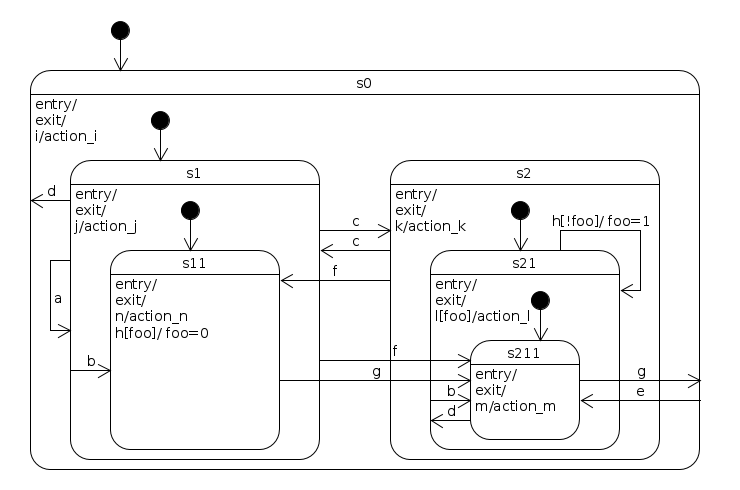
A Hierarchical state machine similar to the one from Miro Samek’s book [1], page 95. It is a state machine that contains all possible state transition topologies up to four levels of state nesting [2]
from pysm import State, StateMachine, Event

foo = True

def on_enter(state, event):
    print('enter state {0}'.format(state.name))

def on_exit(state, event):
    print('exit state {0}'.format(state.name))

def set_foo(state, event):
    global foo
    print('set foo')
    foo = True

def unset_foo(state, event):
    global foo
    print('unset foo')
    foo = False

def action_i(state, event):
    print('action_i')

def action_j(state, event):
    print('action_j')

def action_k(state, event):
    print('action_k')

def action_l(state, event):
    print('action_l')

def action_m(state, event):
    print('action_m')

def action_n(state, event):
    print('action_n')

def is_foo(state, event):
    return foo is True

def is_not_foo(state, event):
    return foo is False


m = StateMachine('m')
s0 = StateMachine('s0')
s1 = StateMachine('s1')
s2 = StateMachine('s2')
s11 = State('s11')
s21 = StateMachine('s21')
s211 = State('s211')

m.add_state(s0, initial=True)
s0.add_state(s1, initial=True)
s0.add_state(s2)
s1.add_state(s11, initial=True)
s2.add_state(s21, initial=True)
s21.add_state(s211, initial=True)

# Internal transitions
m.add_transition(s0, None, events='i', action=action_i)
s0.add_transition(s1, None, events='j', action=action_j)
s0.add_transition(s2, None, events='k', action=action_k)
s1.add_transition(s11, None, events='h', condition=is_foo, action=unset_foo)
s1.add_transition(s11, None, events='n', action=action_n)
s21.add_transition(s211, None, events='m', action=action_m)
s2.add_transition(s21, None, events='l', condition=is_foo, action=action_l)

# External transition
m.add_transition(s0, s211, events='e')
s0.add_transition(s1, s0, events='d')
s0.add_transition(s1, s11, events='b')
s0.add_transition(s1, s1, events='a')
s0.add_transition(s1, s211, events='f')
s0.add_transition(s1, s2, events='c')
s0.add_transition(s2, s11, events='f')
s0.add_transition(s2, s1, events='c')
s1.add_transition(s11, s211, events='g')
s21.add_transition(s211, s0, events='g')
s21.add_transition(s211, s21, events='d')
s2.add_transition(s21, s211, events='b')
s2.add_transition(s21, s21, events='h', condition=is_not_foo, action=set_foo)

# Attach enter/exit handlers
states = [m, s0, s1, s11, s2, s21, s211]
for state in states:
    state.handlers = {'enter': on_enter, 'exit': on_exit}

m.initialize()


def test():
    assert m.leaf_state == s11
    m.dispatch(Event('a'))
    assert m.leaf_state == s11
    # This transition toggles state between s11 and s211
    m.dispatch(Event('c'))
    assert m.leaf_state == s211
    m.dispatch(Event('b'))
    assert m.leaf_state == s211
    m.dispatch(Event('i'))
    assert m.leaf_state == s211
    m.dispatch(Event('c'))
    assert m.leaf_state == s11
    assert foo is True
    m.dispatch(Event('h'))
    assert foo is False
    assert m.leaf_state == s11
    # Do nothing if foo is False
    m.dispatch(Event('h'))
    assert m.leaf_state == s11
    # This transition toggles state between s11 and s211
    m.dispatch(Event('c'))
    assert m.leaf_state == s211
    assert foo is False
    m.dispatch(Event('h'))
    assert foo is True
    assert m.leaf_state == s211
    m.dispatch(Event('h'))
    assert m.leaf_state == s211


if __name__ == '__main__':
    test()
Different ways to attach event handlers
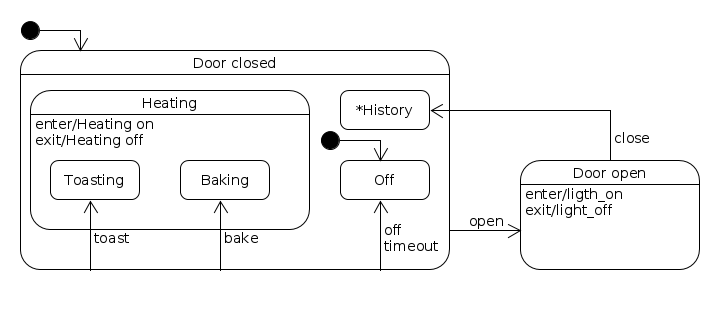
A state machine and states may be created in many ways. The code below mixes
many styles to demonstrate it (In production code you’d rather keep your code
style consistent). One way is to subclass the State class and attach event
handlers to it. This resembles the State Pattern way of writing a state
machine. But handlers may live anywhere, really, and you can attach them
however you want. You’re free to chose your own style of writing state machines
with pysm.
Also in this example a transition to a historical state is used.
import threading
import time
from pysm import StateMachine, State, Event


# It's possible to encapsulate all state related behaviour in a state class.
class HeatingState(StateMachine):
    def on_enter(self, state, event):
        oven = event.cargo['source_event'].cargo['oven']
        if not oven.timer.is_alive():
            oven.start_timer()
        print('Heating on')

    def on_exit(self, state, event):
        print('Heating off')

    def register_handlers(self):
        self.handlers = {
            'enter': self.on_enter,
            'exit': self.on_exit,
        }


class Oven(object):
    TIMEOUT = 0.1

    def __init__(self):
        self.sm = self._get_state_machine()
        self.timer = threading.Timer(Oven.TIMEOUT, self.on_timeout)

    def _get_state_machine(self):
        oven = StateMachine('Oven')
        door_closed = StateMachine('Door closed')
        door_open = State('Door open')
        heating = HeatingState('Heating')
        toasting = State('Toasting')
        baking = State('Baking')
        off = State('Off')

        oven.add_state(door_closed, initial=True)
        oven.add_state(door_open)
        door_closed.add_state(off, initial=True)
        door_closed.add_state(heating)
        heating.add_state(baking, initial=True)
        heating.add_state(toasting)

        oven.add_transition(door_closed, toasting, events=['toast'])
        oven.add_transition(door_closed, baking, events=['bake'])
        oven.add_transition(door_closed, off, events=['off', 'timeout'])
        oven.add_transition(door_closed, door_open, events=['open'])

        # This time, a state behaviour is handled by Oven's methods.
        door_open.handlers = {
            'enter': self.on_open_enter,
            'exit': self.on_open_exit,
            'close': self.on_door_close
        }

        oven.initialize()
        return oven

    @property
    def state(self):
        return self.sm.leaf_state.name

    def light_on(self):
        print('Light on')

    def light_off(self):
        print('Light off')

    def start_timer(self):
        self.timer.start()

    def bake(self):
        self.sm.dispatch(Event('bake', oven=self))

    def toast(self):
        self.sm.dispatch(Event('toast', oven=self))

    def open_door(self):
        self.sm.dispatch(Event('open', oven=self))

    def close_door(self):
        self.sm.dispatch(Event('close', oven=self))

    def on_timeout(self):
        print('Timeout...')
        self.sm.dispatch(Event('timeout', oven=self))
        self.timer = threading.Timer(Oven.TIMEOUT, self.on_timeout)

    def on_open_enter(self, state, event):
        print('Opening door')
        self.light_on()

    def on_open_exit(self, state, event):
        print('Closing door')
        self.light_off()

    def on_door_close(self, state, event):
        # Transition to a history state
        self.sm.set_previous_leaf_state(event)


def test_oven():
    oven = Oven()
    print(oven.state)
    assert oven.state == 'Off'
    oven.bake()
    print(oven.state)
    assert oven.state == 'Baking'
    oven.open_door()
    print(oven.state)
    assert oven.state == 'Door open'
    oven.close_door()
    print(oven.state)
    assert oven.state == 'Baking'
    time.sleep(0.2)
    print(oven.state)
    assert oven.state == 'Off'


if __name__ == '__main__':
    test_oven()
Reverse Polish notation calculator
A state machine is used in the Reverse Polish notation (RPN) calculator as a
parser. A single event name (parse) is used along with specific inputs (See
pysm.pysm.StateMachine.add_transition()).
This example also demonstrates how to use the stack of a state machine, so it behaves as a Pushdown Automaton (PDA)
import operator
import string as py_string
from pysm import StateMachine, Event, State


OPERATORS = {
    '+': operator.add,
    '-': operator.sub,
    '*': operator.mul,
    '/': operator.truediv,
}


class Calculator(object):
    def __init__(self):
        self.sm = self.get_state_machine()
        self.result = None

    def get_state_machine(self):
        sm = StateMachine('sm')
        initial = State('Initial')
        number = State('BuildingNumber')
        sm.add_state(initial, initial=True)
        sm.add_state(number)
        sm.add_transition(initial, number,
                          events=['parse'], input=py_string.digits,
                          action=self.start_building_number)
        sm.add_transition(number, None,
                          events=['parse'], input=py_string.digits,
                          action=self.build_number)
        sm.add_transition(number, initial,
                          events=['parse'], input=py_string.whitespace)
        sm.add_transition(initial, None,
                          events=['parse'], input='+-*/',
                          action=self.do_operation)
        sm.add_transition(initial, None,
                          events=['parse'], input='=',
                          action=self.do_equal)
        sm.initialize()
        return sm

    def parse(self, string):
        for char in string:
            self.sm.dispatch(Event('parse', input=char))

    def calculate(self, string):
        self.parse(string)
        return self.result

    def start_building_number(self, state, event):
        digit = event.input
        self.sm.stack.push(int(digit))
        return True

    def build_number(self, state, event):
        digit = event.input
        number = str(self.sm.stack.pop())
        number += digit
        self.sm.stack.push(int(number))
        return True

    def do_operation(self, state, event):
        operation = event.input
        y = self.sm.stack.pop()
        x = self.sm.stack.pop()
        result = OPERATORS[operation](float(x), float(y))
        self.sm.stack.push(result)
        return True

    def do_equal(self, state, event):
        operation = event.input
        number = self.sm.stack.pop()
        self.result = number
        return True


def test_calc_callbacks():
    calc = Calculator()
    assert calc.calculate(' 167 3 2 2 * * * 1 - =') == 2003
    assert calc.calculate('    167 3 2 2 * * * 1 - 2 / =') == 1001.5
    assert calc.calculate('    3   5 6 +  * =') == 33
    assert calc.calculate('        3    4       +     =') == 7
    assert calc.calculate('2 4 / 5 6 - * =') == -0.5

if __name__ == '__main__':
    test_calc_callbacks()
Queued dispatch
QueuedStateMachine is useful when handlers may dispatch more events and
you want deterministic run-to-completion scheduling.
from pysm import Event, State
from pysm.queued import QueuedStateMachine

calls = []
machine = QueuedStateMachine('m')
a = State('a')
b = State('b')

def enter_b(state, event):
    calls.append('enter_b')
    machine.dispatch(Event('finish'))
    calls.append('enter_b_returned')

b.handlers = {'enter': enter_b}
machine.add_state(a, initial=True)
machine.add_state(b)
machine.add_transition(a, b, events=['go'])
machine.add_transition(
    b, None, events=['finish'],
    action=lambda state, event: calls.append('finish'))
machine.initialize()

machine.dispatch(Event('go'))
assert calls == ['enter_b', 'enter_b_returned', 'finish']
Async dispatch
AsyncQueuedStateMachine awaits async handlers, conditions, and transition
callbacks while preserving the same callback order as the synchronous runtime.
from pysm import Event, State
from pysm.aio import AsyncQueuedStateMachine

async def main():
    machine = AsyncQueuedStateMachine('m')
    idle = State('idle')
    ready = State('ready')

    async def enter_ready(state, event):
        await machine.dispatch(Event('validate'))

    ready.handlers = {'enter': enter_ready}

    machine.add_state(idle, initial=True)
    machine.add_state(ready)
    machine.add_transition(idle, ready, events=['go'])
    machine.add_transition(ready, None, events=['validate'])
    machine.initialize()

    await machine.dispatch(Event('go'))
    assert machine.leaf_state is ready
Snapshot and restore
The serialization helper stores active machine state as plain Python data. Recreate the same graph, initialize it, and then restore the snapshot.
from pysm import Event
from pysm.builder import StateMachineBuilder
from pysm.serialization import restore, snapshot

def build_toggle():
    return (StateMachineBuilder('toggle')
            .state('off', initial=True)
            .state('on')
            .transition('off', 'on', events='turn_on')
            .transition('on', 'off', events='turn_off')
            .build())

machine = build_toggle()
machine.dispatch(Event('turn_on'))
data = snapshot(machine, metadata={'source': 'example'})

restored = build_toggle()
restore(restored, data)

assert restored.leaf_state.name == 'on'
Footnotes